Showing posts with label homework help. Show all posts

Friday, March 13, 2015

11 Best Questions To Ask The Teacher At Parent/Teacher Conferences


I  just recently had a parent/teacher conference with my son’s teacher.  He’s in kindergarten, so this is my first rodeo dealing with public schools as a parent.  This was our 3rd conference this school year.  After the first two conferences, I walked away frustrated each time.  I felt like the teacher simply gave me generic information about my child.  Nothing that she said to me helped me to truly understand his progress or lack thereof.  I felt like she wasn’t really listening to what I needed her to hear in regards to the needs of my child and therefore, I felt as if my child was not getting what he needed. There was a breakdown somewhere and I just couldn’t get past that.  The teacher was very prepared to provide evidence of my child’s work but couldn’t tell me anything about goals, potential, or what to expect in the future.  Again, simply telling me how he’s performed thus far only minimally helps me to direct his education and my support of it in the future.

Yesterday, while beginning a tutoring session with a client, the parent mentioned to me that she has a parent/teacher conference coming up for her children.  She asked me what she should ask the teacher.  I thought for a second and was ready with an immediate response.  I told her to ask very specific questions that require detailed responses from the teacher.  I mentioned to her that I had prepared several questions ahead of time to ask the teacher before the conference.  I had also sent an email to request the conference and it stated specifically what I wanted to discuss in regards to my son’s performance in class.  I told her that if she wanted to avoid the generic responses of “your child’s doing great” or “they’re just not getting it” then she has to ask the right questions.

Let’s redirect back to the most recent conference I had with my son’s teacher.  Because I sent the email prior to our meeting to discuss the things that were important for me to understand in helping my child, the teacher was able to be prepared to focus specifically on those things.  It kept us on track during the entire meeting.  I didn’t walk away frustrated either because I was satisfied with the information she gave me.  I was equipped to be able to help my son in the future because I asked specific questions.  I have provided a list of questions to ask the teacher during the conference to gain clarification of your child’s performance (other than a grade/score).  Feel free to edit/modify the questions per teacher or subject. Read this article to find out how to craft the best email prior to a conference.

11 Best Questions to ask a teacher during a parent/teacher conference:

     1. What is a day in your class like?

Beginning with this type of question relaxes the tension (if any) and gives you a glimpse inside of a normal day that your child experiences.  Let’s face it, they don’t tell us everything and they may exaggerate things a little in terms of what goes on (or doesn’t) in class.


     2.  Is my child reading (doing his work) in class and/or participating daily?

This question is important because it gives you a glimpse into how your child functions in class everyday.  It has the opportunity to shed some light on why their skills may or may not be improving or why they are/aren’t understanding the material without having to point the finger at any one person.


     3.  Does my child ask questions in class? How often?

You need to know about your child’s interactions with the teacher during instructional time.  If they consistently aren’t understanding the material, it is important that you encourage them to ask questions (if they aren’t already).


     4.  How often do you assign homework? Approximately how much time should the average student spend on your homework assignments? What is the level of difficulty in completing those assignments? Are the assignments graded and does my child receive feedback? How is my child performing on these assignments? What percent of his/her grade is directly related to homework?
                                  
Homework may be for enrichment, remediation, extension, or practice. If you notice that your child either does not have any homework or has a lot, these questions help you to gauge the importance placed on homework. Once you know the value of homework in each teacher’s class, you can effectively guide your child during that time.

These questions also help to explain your child’s overall grade.


     5.  What is my child’s potential?  What do you feel he/she is capable of?

Understanding your child’s potential is pertinent for you and the teacher in order to understand the needs of your child and how to motivate them.  If they give them work that is too easy, they risk boring them and your child eventually losing interest in school.  If they give them work that is too challenging, they risk becoming unmotivated to try because they feel they can’t get anything right.

Asking specifically about what your child is capable of is crucial to help you push them and motivate them at home.  The answer to this question lets you know exactly what they can do.


     6.  Is my child capable of doing more than what he/she is currently doing?

A question like this one gauges how well the teacher knows your child.  It helps to determine whether or not your child is getting the attention needed from the teacher.  If the teacher is unable to determine your child’s capabilities then it will be difficult for them to provide work at a level that is best for your child to succeed.

You can use the answer to this question for leverage at home when you discuss their performance in school.  Again, this helps you to push and motivate your child.


     7.  What specific concepts does my child need to improve upon and what concepts has he/she mastered?

The key phrase in this question is “specific concepts.” Be sure that the teacher doesn’t generalize in answering this question. 

For example, telling you that your child needs help with reading comprehension is very general and broad as an explanation.  The teacher should be able to mention types of reading genres or specific types of reading comprehension questions that your child has problems understanding and recalling. He/she may very well understand and comprehend fiction or poetry but doesn’t comprehend non-fiction works very much.  Your child may understand cause and effect but not inference type questions.

Another example of a broad answer is saying that your child needs help with fractions.  Your question should then be, “do you mean multiplying, dividing, adding, subtracting, or all of the above? Does he/she need help understanding like or unlike denominators or both?”


     8.  What goals have you set for my child specifically in… (list each subject)? What steps are necessary to accomplish these goals?

Setting goals is important to monitor progress.  Remember that goals should be measured and have a time frame for completion.  Don’t let the teacher simply say, “by the end of the school year.” That’s a very generic answer. Also, don’t let them simply refer to the “standards” as a specific goal.  That too is a very generic answer.

A good example of a goal is: I want him/her to increase to Reading Level G within the next month. Another good example: He/she should know all of their multiplication facts through 8 within 6-8 weeks.

It is pertinent to know more than just the goals.  Knowing how to accomplish those goals says that there is a plan and this is how we’re going to implement it. It allows you, as the parent, the opportunity to participate in helping your child to reach those goals because you understand the road to take to get there.


     9.  Will you revise those goals if/when they are reached? How will you communicate those changes to me when the time comes?

These questions ensure that there will be continuous monitoring towards your child’s progress. Not only does it let the teacher know that you plan to be involved every step of the way but it lets them know that you plan to hold them accountable to communicating your child’s progress with you.

This is an opportunity to set up an acceptable form of communication whether it’s email, note home, or phone call. It may be wise to set up a communication schedule with the teacher as well (i.e. every 2-3 week check-up).

     10. Do you offer tutoring before or after school? If so, what day(s) of the week and what time(s)? If not, are there any other teachers that you could recommend who offer tutoring before or after school?

Avoid asking whether or not your child needs tutoring. I suggest allowing them to go whether they need to or not.  It’s beneficial for the teacher to see them putting forth the extra effort in the long run. It’s also beneficial for your child to learn how going beyond what they are currently working on to get ahead is important.

Some teachers may discourage tutoring if they feel the child is on target or will be on target soon. Always err on the side of caution.  Remember, it’s better to be safe, than sorry. A little extra knowledge and preparation never hurt anyone!

     11. How can my child improve in your class? In addition to homework, what should my child be doing to stay prepared for your class?

This is a great set of questions to close out the meeting.  It let’s the teacher know that you are 100% on board to making sure that your child does his/her absolute best in your class. It also gives you the final information needed to assist your child at home and in school.


Notice that these questions shift far away from an extremely negative, emotional, and intense conversation about your child.  The focus stays strictly on student, teacher, and parent performance and accountability.  The questions remove the notion of finger-pointing and blaming and concentrate on sharing the responsibilities of educating your child.  This helps for a better relationship for all parties involved.

Are there questions that you’ve asked your child’s teacher that you think should be on this list?

Monday, February 23, 2015

6 Reasons Why You Should Know Your Child's Learning Style

How can we teach children to think for themselves if we don’t know how they think?  How can children learn to think for themselves if they don’t know they learn?  The way a child learns affects his/her entire personality and development. Having a full understanding of his/her learning style means that a child has an understanding of how they function as an individual.

n  A learning style is…
         a way to take in and process information
         different approaches or ways of learning
         a preference that gets stronger the more it is used
         the way the mind operates
         the way we learn!

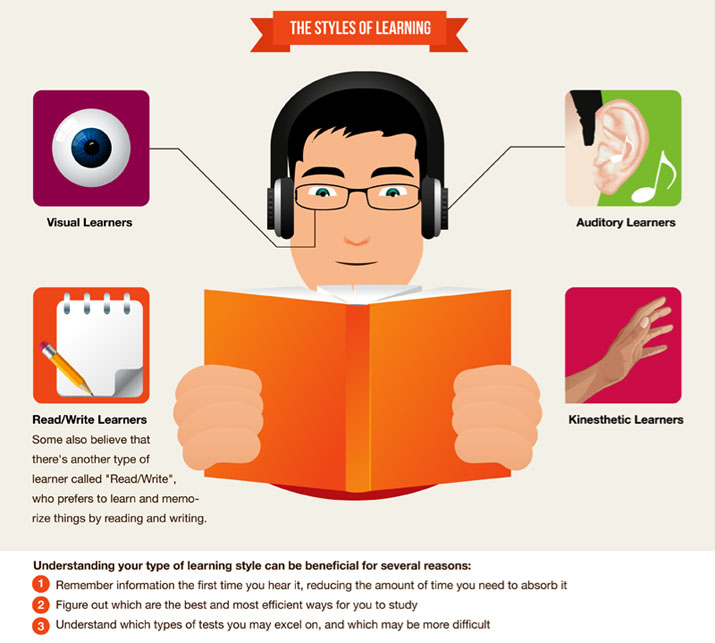
There are 3 main types of learning styles: visual, auditory, and kinesthetic.  Visual learners process and learn new information by seeing things, auditory by listening and kinesthetic by movement and a hands-on approach. Most people share some characteristics of more than one learning style but have a strong preference usually for one style.  It is important that you learn your children’s learning style as well as your own. The reasons below explain why.

auditory, visual, kinesthetic, tutoring, comprehension


Reasons why knowing your child’s learning style is important:

1. You now know and understand how they think

  • Knowing their learning style helps you to figure out how they process information and their style of thinking.  If you know how they think, you’re better able to break information down in a way that they understand it.

2. It helps to explain their personality

  • Once you discover their learning styles, their personalities make much more sense. For instance, auditory learners talk a lot and like to debate.  Because they learn by hearing, it’s no wonder they like to hear themselves talk. Kinesthetic learners are busy-bodies.  They simply cannot sit still; moving helps them process information.

3. It helps you to communicate with them better

  • Once you know how your child learns, it’s easier to determine how to communicate with them.  Giving verbal directions works well for auditory learners but not for visual learners. Visual learners need their directions written down for reinforcement. The more you know about your child’s learning style, the better your relationship can become due to better communication.

4. It helps you to help them study

  • Understanding your child’s way of learning helps you to determine what methods of learning best fit their needs.  Once you figure that out, it’s easier to implement effective study strategies. An example for visual learners is to utilize videos to demonstrate concepts or ideas.  They will benefit more from seeing the video than you simply describing what to do.

5. It helps you understand their behavior

  • Some of your child’s behavior may be explained by their learning styles.  Familiarizing yourself with the characteristics of your child’s learning style will help you to understand why they act a certain way and aid you in addressing them appropriately and with more patience.  For example, parents of kinesthetic learners find it difficult to get them to sit still while doing their work.  Instead of becoming frustrated and forcing them to sit still, allow for structured movements such as bouncing on an exercise ball or doing a celebratory dance when they are done reading or have completed a math problem correctly.

6. It makes for a better relationship

  • Once you understand your child’s learning style (and your own), the communication between the two of you gets better, your are able to apply effective strategies to manage their behavior, you know how they think and begin to use that to help them study effectively and even apply it to non-academic areas, your relationship with your child should improve.  The best relationships are those in which each one understands one another and can communicate better.

Take a quick learning style assessment and have your child to take an age-appropriate learning style inventory. Check out more information about learning style personalties and resources for study skills.

Sign up now for FREE CLASSES that will go into detail about how to utilize learning styles to be successful in school and at home.


Friday, September 20, 2013

3 Reasons Why Waiting to Get Help is a BAD IDEA


 CAN YOUR CHILD AFFORD FOR YOU TO WAIT?


School has begun.  Students are settled.  The grades are in.  Students should have received their progress report by now.  The first progress report is an important indicator into your child's academic performance.  Are they failing, barely passing, passing, or excelling? Everyone should want their child to excel.  No one certainly wants them to fail.  So, don't take this first progress report for granted or brush it off.  If the grades aren't good, it indicates that your child needs help and waiting may not be the best solution.

"An ounce of prevention is worth a pound of cure"
-Benjamin Franklin
You may have heard this saying before.  Simply put (in the world of education), it means that if you plan, prepare, and get help early, you may prevent failure.  Just a little help early on makes a world of difference in the end.  We get calls from parents all of the time and they tell us that they will "wait to see" if their child will pull his/her grades up without establishing an effective plan to do so.  Another saying states that "a failure to plan is a plan to fail." Other times, parents call us after they've waited until it was almost too late to get their child some help with their academics.  
We want to help you prevent failure by helping you to understand why it isn't a good idea to wait.


3 Reasons Why Waiting is 
NOT a Good Idea!
Reason 1 
Loss of Confidence 
A child's confidence is connected to how well they perform--their success. If your child starts off doing well their confidence increases.  If they perform poorly on assignments, eventually their confidence will become affected by it.  They may begin to give up easily or stop trying altogether.  Their class participation may dwindle or they may withdraw during class.  Why should they keep trying if they keep getting the wrong answers? It is important to take notice of your child's behavior and attitude as it relates to their schoolwork. The more they fail, the less enthusiastic and motivated they become.  This increases the likelihood of continued failure.  You have to intervene as soon as your child begins to struggle and either provide the extra assistance they need or find someone who can.  Your child cannot wait!
Reason 2 
Falling Behind                                    

Most of the information that students learn in school builds upon one another.  This not only occurs from lesson to lesson and unit to unit, it occurs from one grade level to the next.  It is important that foundations of knowledge are established and understood before moving on to the next level.  Many students misunderstand or lack the foundation of skills learned at the beginning of the school year or during the previous school year to be successful in their classes. So, they fall behind.  If they do not catch up as soon as possible, they continue to fall behind making it extremely difficult to understand any new material covered by the teacher.  When they say, "I just don't get it," this may be an indication that there are some issues with understanding basic concepts that were taught.  Understand that this leads to frustration, stress, and the possibility of failure.  Can your child afford to retake a test or class or to redo an assignment?  As one saying puts it, "if you don't have time to do it right, you must have time to do it again."  Give your child a chance to do it right and not to have to do it again.  Don't wait until the last minute to get them the help they need.  Find a tutor now!
Reason 3 
It's Stressful                                     

Have you ever been stressed? It's not a good feeling.  So, just imagine how a child feels when dealing with the pressures related to passing a test or doing well on an assignment when they don't understand the information.  They get upset or frustrated and that makes it hard to complete the assignment.  Stress affects a student's ability to focus and concentrate because he/she is so worried about getting the wrong answer.  Stress also affects behavior and the ability to sleep well at night.  It even affects a person's health.  If I child falls behind in school, stress is a possible outcome.  It may affect a child mentally, physically, emotionally, behaviorally, and/or psychologically.  Make life easier and stress free for your child.  Get them the help they need and deserve by not waiting until they fail.  Find someone to provide academic tutoring and support today! Can you afford to wait?
Accelerated Learning Services wants to help you!
Even if your child is doing well in his/her classes getting help to reinforce concepts won't hurt.  It's okay to have them participate in tutoring every 2 weeks in order to maintain good grades or improve.  For children who are not doing well based on the last progress report received, we encourage you to get tutoring assistance immediately.  Give us a call at 
855-388-8676 or visit us on the web at www.alstutoring.com for tutoring and test prep. We will be glad to speak with you and assist you in any way possible.
Connect with Us for Specials & Updates
Like Twitter

Thursday, January 3, 2013

How To Prevent Students From Failing Part II

12 Ways To Prevent Students From Failing Part II
(A Guide for Parents and Students)
By: Aquarius Cain
Accelerated Learning Educational Services


            1.      Communicate With Teachers Regularly
It’s important to build a good relationship with teachers.  Communicate with them weekly to make sure that homework assignments were turned in on time, classwork is being completed, etc.  Ask for make-up work ahead of time when you know absences will occur.  Get an advanced notice on major assignments and upcoming projects.  Let them know that you are not a threat; you just want to stay informed and are willing to assist in any way to ensure a fair grade.

Schedule a conference with the teacher monthly to receive feedback on student performance.  DO NOT WAIT UNTIL GRADE REPORTS ARE SENT HOME.  By the time grade reports are sent home, the damage may have already been done and you may not be able to reverse the damage.

            2.      Get Organized
·         Organization is the key to success! To be organized, first de-clutter lockers, back packs, and notebooks; sort through the papers and separate them by subject.  DON’T THROW ANYTHING AWAY…YOU MAY NEED IT LATER!
·         Try to keep the notebook in a particular order so that it’s easier to find things
·         Have a system to communicate between parents, students, and teachers by having a: Home/School Communication Folder
·         Students remember more if they do homework in the same place and same time each day! So, it’s important to have a workstation and a study schedule.

Read this article to find out more about how to stay organized: How To Be Successful in School

            3.      Understand How You Learn
Students learn differently! However, many teachers do not teach differently (that is, according to the way each student learns).  Teaching to the multiple modes of learning is called differentiated learning. The modes of learning are visual, auditory, or kinesthetic. 

Students should take a Learning Styles Assessment to determine exactly how they learn:
·         Visual learners learn by reading and seeing things written down or drawn into pictures.
·         Auditory learners learn by hearing and discussing information.
·         Kinesthetic learners learn by practicing and doing things over and over until they understand it.

After taking a Learning Styles Assessment, use study techniques that will help you learn new information based on your learning style.


            4.      Know When To Ask For Help
One of the easiest ways to prevent failure is to know when to ask for help and to actually ask for help. Students should always raise their hand in class and ask questions when they do not understand.  It is important to understand that no question is a stupid question and that there is probably someone else who doesn’t understand and is waiting for someone to ask for an explanation.  If not you, then who?

If students are afraid to ask questions in class then they should ask the teacher after or in-between classes or schedule an appointment to get further help.  This is also where extra tutoring with the teacher may be needed.
            5.      Stay Positive/Be Encouraged
To prevent failure, it is imperative to keep a positive attitude.  “If you believe, you can achieve.”  Even when things get tough, students should continue to encourage themselves by using compliments and positive mantras.  Being surrounded by friends who are encouraging and positive is a helpful way to stay positive and encouraged as well.

Students should know and understand that they may not be successful at everything and with every assignment, and that’s ok.  Everyone fails eventually but it is important to keep trying and to always do your best.
            6.      Reward Progress
As small goals are met, such as turning in all homework assignments this week, celebrate those accomplishments.  Go and grab ice cream or rent a favorite movie.  Rewards also help to keep students motivated and encouraged.  It is imperative to reward small things just as much as major accomplishments.  Some students may make all C’s and rewarding them for consistency is good while making the next incentive greater if they can make a B, for example.

Figure out what works but don’t overdo it to the point where it backfires and students begin to expect rewards for performance.

Friday, December 28, 2012

How To Prevent Students From Failing Part I


12 Steps To Prevent Students From Failing Part I
Tips for Students and Parents

By: Aquarius Cain
             1.      Get a Tutor
“An ounce of prevention is worth a pound of cure” (Benjamin Franklin). Waiting until a student fails is the biggest mistake most people make. Most times the excuse is, “I don’t want to waste money if they don’t need it and can get it on their own.” If a student struggled, failed, or barely passed first semester, chances are they will also struggle, fail or barely pass second semester.  The reason being is that the material may not get easier but more difficult.  Additionally, most of the concepts will build upon what was learned first semester and if there wasn’t a full understanding of it then, it will be difficult to understand the new material now.

We suggest having a personal tutor once a week to reinforce what was learned in class and answer any questions that may not have been answered to the student’s understanding from class.  Going to tutoring before or after school with the teacher is also a good way to prevent from failing. Group tutoring or forming study groups are other ways to master learning and to get better grades in school. Students studying together is always an effective way to share information and learn from one another.

Figure out which options work best but do not skimp on getting tutoring even if things seem to be going ok initially.  Tutoring is a good investment with the ultimate return being SUCCESS!


             2.      Monitor homework
·         Write down homework assignments and due dates on a homework checklist or in an agenda.  A homework checklist prevents you from forgetting about all of the assignments and helps to keep track of what assignments are left to finish.
·         Make sure the instructions are understood as well.  Ask questions about the assignment before leaving class for clarity.  There’s nothing worse than getting home to start working on homework only to realize you have no clue what to do. 
·         Get started on the homework assignments immediately and do not wait until the last minute to get them done.  If it will take several days to complete, break the assignment up into chunks or sections and complete a few sections each day until complete.
·         Check homework for completion and accuracy and make necessary changes. 
·         Check off the assignment on the homework checklist as soon as it is completed. 
·         Have a homework folder to place completed assignments in so that you do not lose your work.
·         TURN THE ASSIGNMENT IN ON TIME!  I cannot stress this enough.  If you’re going to take the time to do the work, why not get the full credit?

Most school systems have an online grading system where grades can be tracked simply by logging in.  Check grades regularly (weekly) to monitor and make sure credit is given to assignments that have been completed and turned in.  Ask questions about grades that are low or missing.


              3.      Set a Reasonable Schedule
Study time and homework time is necessary, especially for establishing study habits.  Assess student energy levels and find a time to study and do homework when they are the most functional.  If students need a break or nap right after school or class then do not schedule homework/study time until later.  For those who are very energetic when they get home, they should begin studying immediately after school. Don’t forget to schedule breaks.  Take a 10-15 minute break every 45 minutes to an hour. Use a calendar or study schedule template to set up the schedule.


Studying should be done daily for at least 15 minutes per subject.  Do not confuse studying with homework time.  Studying is reviewing material and making sure that you understand it by assessing student knowledge through quizzes, question/answer sessions, etc.  Homework is reinforcement of skills and knowledge.


             4.      Limit Video Games/TV Time
Of course, students will choose to play video games, watch television, and/or be on the internet over studying and doing homework. It’s more fun!  Television, video games, and the internet pose a huge distraction and may contribute to a student failing (unless it is related to academics).  This is because, if given the option, students will spend more time gaming, watching TV, browsing the web, and being on social networking sites than they will studying.  Students also tend to lose focus more easily and are unable to concentrate.

It is suggested to limit technology time to about an hour a day during the school week and extend the time on the weekends.  For students who are highly addicted and struggle significantly at school, try to limit this technology time to weekends only (Friday through Sunday).  Educational games, shows, and websites are highly encouraged.  Go to our website www.acceleratedlearningservices.com for a list of recommended websites.

One thing to caution about limiting technology time is using it as a reward for finishing homework.  This sends a message that homework is not very important and that video games, etc. are more fun. 

              5.      Encourage Reading
·         If failure is to be prevented, reading must be implemented into the daily schedule.  Reading more will improve comprehension and understanding of information.  The more students read, the more it becomes a habit, and the more they will enjoy it!
·         Students should read approximately 10-30 minutes a day depending on their age. 
·         Choose different things to read, such as magazines, comic books, literature, cereal box, recipes, novels, video game instructions, etc. 
·         Set weekly reading goals and discuss small rewards for reaching those goals.

             6.      Check Grades Weekly
To prevent failure, it is important to check and track grades weekly.  Ask to see quizzes, tests, and homework once it has been graded and keep your own record of those grades for accuracy. Use a simple spreadsheet like the one below.

Ask to redo assignments, tests, and quizzes (even if you will not get a better grade by doing so). It shows the teacher that you are interested in learning the information that you did not answer correctly.  They may see your effort and be willing to give you partial credit.

Tuesday, September 18, 2012

How To Be Successful in School: Part I


Part I: GET ORGANIZED

By Aquarius Cain
(CEO of Accelerated Learning Educational Services)


Do you spend a lot of time looking for homework and assignments?

Is your locker or book bag packed with crumpled pieces of paper?

Do you feel stressed because you constantly lose things?

Are your grades slipping because of missing/lost assignments or incomplete assignments?

Do you find yourself making excuses about why you don’t have your work?


If you can’t answer these questions with a solid “NO” 
IT IS TIME TO ORGANIZE YOUR LIFE!!!! 
 

In order to organize your life, you need to:

Ø  Organize your papers/notebook

Ø  Organize your backpack

Ø  Organize your locker

Ø  Organize your workspace

Ø  Organize your schedule
 

To be organized, you must first de-clutter your locker, back pack, and notebook; sort through the papers and separate them by subject.  DON’T THROW ANYTHING AWAY…YOU MAY NEED IT LATER!

 
Organize Your Notebook

 
Notebook Contents 

·         3-ring binder: 2” rings or larger w/pockets in the covers

·         5-6 colored tab subject dividers (colored construction paper works)

·         Zipper pouch to store supplies (hole punched zip-lock bags work)

·         2+ pens & pencils

·         Filler paper

·         Assignment Calendar for EACH CLASS

·         Divider pouches (for papers with no holes)

·         Highlighters

·         Ruler/hole puncher

·         Calculator
Color code your notebooks to make it easier to stay organized    

·         Assign every subject a color

·         Match your notebook/binder tab color to the folder color

·         Use colored tabs

·         On journals & workbooks, use a marker to stripe the pages with the color for that subject


Try to keep your notebook in a particular order so that it’s easier to find things

·         Put a front cover on your binder

·         For Each section/subject

o   Divider (preferably with pockets)

o   Completed assignments that need to be turned in (front pocket)

o   Calendar/assignment log

o   Notes

o   Handouts

o   Returned assignments/tests

o   Blank paper
Home/School Communication Folder 

Another way to get organized is to have a system to communicate between parents and students by having a: Home/School Communication Folder

How This Works 

1.      At school - put papers for parents in your Home/School Folder

2.      When you get home - put papers in your School Zone (designated area to put papers)

3.      Have parents check School Zone

4.      Put signed papers back in Home/School Communication Folder

5.      Take Home/School Folder back to school & turn in necessary papers


School Zone

·         Special place where you put parent papers, a place your parents check every day

·         Could be a basket or a bulletin board

·         Great place for notes for teacher, field trip permission slips etc.

·         Leave yourself reminder notes in your School Zone


Student Work Area

·         What does your current work area look like?

·         How should it look?

o   It should be neat & clean

o   It should be in a well lit area

o   It should be in a place with no distractions

o   Make sure it is equipped with Necessary supplies

·         You remember more if you do your homework in the same place and same time each night!


Visit www.acceleratedlearningservices.com for resources to help you stay organized.

If you would like for a representative to speak about organization skills at your school, church, or organization, please contact 404-933-2235.