Showing posts with label learning style. Show all posts

Monday, February 23, 2015

6 Reasons Why You Should Know Your Child's Learning Style

How can we teach children to think for themselves if we don’t know how they think?  How can children learn to think for themselves if they don’t know they learn?  The way a child learns affects his/her entire personality and development. Having a full understanding of his/her learning style means that a child has an understanding of how they function as an individual.

n  A learning style is…
         a way to take in and process information
         different approaches or ways of learning
         a preference that gets stronger the more it is used
         the way the mind operates
         the way we learn!

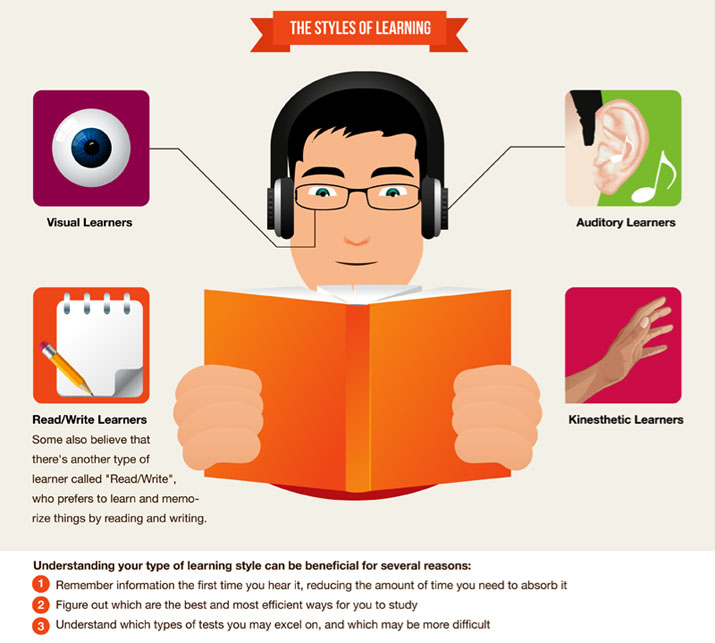
There are 3 main types of learning styles: visual, auditory, and kinesthetic.  Visual learners process and learn new information by seeing things, auditory by listening and kinesthetic by movement and a hands-on approach. Most people share some characteristics of more than one learning style but have a strong preference usually for one style.  It is important that you learn your children’s learning style as well as your own. The reasons below explain why.
auditory, visual, kinesthetic, tutoring, comprehension


Reasons why knowing your child’s learning style is important:

1. You now know and understand how they think

  • Knowing their learning style helps you to figure out how they process information and their style of thinking.  If you know how they think, you’re better able to break information down in a way that they understand it.

2. It helps to explain their personality

  • Once you discover their learning styles, their personalities make much more sense. For instance, auditory learners talk a lot and like to debate.  Because they learn by hearing, it’s no wonder they like to hear themselves talk. Kinesthetic learners are busy-bodies.  They simply cannot sit still; moving helps them process information.

3. It helps you to communicate with them better

  • Once you know how your child learns, it’s easier to determine how to communicate with them.  Giving verbal directions works well for auditory learners but not for visual learners. Visual learners need their directions written down for reinforcement. The more you know about your child’s learning style, the better your relationship can become due to better communication.

4. It helps you to help them study

  • Understanding your child’s way of learning helps you to determine what methods of learning best fit their needs.  Once you figure that out, it’s easier to implement effective study strategies. An example for visual learners is to utilize videos to demonstrate concepts or ideas.  They will benefit more from seeing the video than you simply describing what to do.

5. It helps you understand their behavior

  • Some of your child’s behavior may be explained by their learning styles.  Familiarizing yourself with the characteristics of your child’s learning style will help you to understand why they act a certain way and aid you in addressing them appropriately and with more patience.  For example, parents of kinesthetic learners find it difficult to get them to sit still while doing their work.  Instead of becoming frustrated and forcing them to sit still, allow for structured movements such as bouncing on an exercise ball or doing a celebratory dance when they are done reading or have completed a math problem correctly.

6. It makes for a better relationship

  • Once you understand your child’s learning style (and your own), the communication between the two of you gets better, your are able to apply effective strategies to manage their behavior, you know how they think and begin to use that to help them study effectively and even apply it to non-academic areas, your relationship with your child should improve.  The best relationships are those in which each one understands one another and can communicate better.

Take a quick learning style assessment and have your child to take an age-appropriate learning style inventory. Check out more information about learning style personalties and resources for study skills.

Sign up now for FREE CLASSES that will go into detail about how to utilize learning styles to be successful in school and at home.


Thursday, January 3, 2013

How To Prevent Students From Failing Part II

12 Ways To Prevent Students From Failing Part II
(A Guide for Parents and Students)
By: Aquarius Cain
Accelerated Learning Educational Services


            1.      Communicate With Teachers Regularly
It’s important to build a good relationship with teachers.  Communicate with them weekly to make sure that homework assignments were turned in on time, classwork is being completed, etc.  Ask for make-up work ahead of time when you know absences will occur.  Get an advanced notice on major assignments and upcoming projects.  Let them know that you are not a threat; you just want to stay informed and are willing to assist in any way to ensure a fair grade.

Schedule a conference with the teacher monthly to receive feedback on student performance.  DO NOT WAIT UNTIL GRADE REPORTS ARE SENT HOME.  By the time grade reports are sent home, the damage may have already been done and you may not be able to reverse the damage.

            2.      Get Organized
·         Organization is the key to success! To be organized, first de-clutter lockers, back packs, and notebooks; sort through the papers and separate them by subject.  DON’T THROW ANYTHING AWAY…YOU MAY NEED IT LATER!
·         Try to keep the notebook in a particular order so that it’s easier to find things
·         Have a system to communicate between parents, students, and teachers by having a: Home/School Communication Folder
·         Students remember more if they do homework in the same place and same time each day! So, it’s important to have a workstation and a study schedule.

Read this article to find out more about how to stay organized: How To Be Successful in School

            3.      Understand How You Learn
Students learn differently! However, many teachers do not teach differently (that is, according to the way each student learns).  Teaching to the multiple modes of learning is called differentiated learning. The modes of learning are visual, auditory, or kinesthetic. 

Students should take a Learning Styles Assessment to determine exactly how they learn:
·         Visual learners learn by reading and seeing things written down or drawn into pictures.
·         Auditory learners learn by hearing and discussing information.
·         Kinesthetic learners learn by practicing and doing things over and over until they understand it.

After taking a Learning Styles Assessment, use study techniques that will help you learn new information based on your learning style.


            4.      Know When To Ask For Help
One of the easiest ways to prevent failure is to know when to ask for help and to actually ask for help. Students should always raise their hand in class and ask questions when they do not understand.  It is important to understand that no question is a stupid question and that there is probably someone else who doesn’t understand and is waiting for someone to ask for an explanation.  If not you, then who?

If students are afraid to ask questions in class then they should ask the teacher after or in-between classes or schedule an appointment to get further help.  This is also where extra tutoring with the teacher may be needed.
            5.      Stay Positive/Be Encouraged
To prevent failure, it is imperative to keep a positive attitude.  “If you believe, you can achieve.”  Even when things get tough, students should continue to encourage themselves by using compliments and positive mantras.  Being surrounded by friends who are encouraging and positive is a helpful way to stay positive and encouraged as well.

Students should know and understand that they may not be successful at everything and with every assignment, and that’s ok.  Everyone fails eventually but it is important to keep trying and to always do your best.
            6.      Reward Progress
As small goals are met, such as turning in all homework assignments this week, celebrate those accomplishments.  Go and grab ice cream or rent a favorite movie.  Rewards also help to keep students motivated and encouraged.  It is imperative to reward small things just as much as major accomplishments.  Some students may make all C’s and rewarding them for consistency is good while making the next incentive greater if they can make a B, for example.

Figure out what works but don’t overdo it to the point where it backfires and students begin to expect rewards for performance.