
Providing tutoring, test prep, organization skills, time management, school safety, education, and school success tips
Tuesday, May 10, 2016

Tuesday, September 22, 2015
Accelerated Learning Services Referral Program
We're excited everyday as you, our customers and fans, share and refer Accelerated Learning Services to others. Whether it is done online, face-to-face, or through a text message, your referrals have been a mainstay of what keeps us going daily.
So, to all of you that have been referring us, and all of you that are thinking about it, things just got a whole lot easier, interactive, and much more rewarding!
We have a great referral program that allows you to earn free tutoring or cash by inviting your friends! To access and read more about the Accelerated Learning Services Referral Program, go to our website and click on "Earn Free Tutoring."

So, to all of you that have been referring us, and all of you that are thinking about it, things just got a whole lot easier, interactive, and much more rewarding!
We have a great referral program that allows you to earn free tutoring or cash by inviting your friends! To access and read more about the Accelerated Learning Services Referral Program, go to our website and click on "Earn Free Tutoring."

It gets better; everything is tracked by your name and phone number. You can invite up to 5 friends at a time or they can complete the form and add your name as the person referring. You'll earn $20 cash or up to 2 months of free tutoring (details).
So if you've been thinking about sharing Accelerated Learning Services with your colleagues and network, go ahead and share away! Invite your friends today and start earning. We'll continue to do our part by providing quality tutoring to every client.
 |
| Scan the QR code to invite friends |
Friday, March 13, 2015
11 Best Questions To Ask The Teacher At Parent/Teacher Conferences

I just recently had a parent/teacher conference
with my son’s teacher. He’s in
kindergarten, so this is my first rodeo dealing with public schools as a
parent. This was our 3rd conference
this school year. After the first two
conferences, I walked away frustrated each time. I felt like the teacher simply gave me
generic information about my child.
Nothing that she said to me helped me to truly understand his progress
or lack thereof. I felt like she wasn’t
really listening to what I needed her to hear in regards to the needs of my
child and therefore, I felt as if my child was not getting what he needed.
There was a breakdown somewhere and I just couldn’t get past that. The teacher was very prepared to provide
evidence of my child’s work but couldn’t tell me anything about goals,
potential, or what to expect in the future.
Again, simply telling me how he’s performed thus far only minimally
helps me to direct his education and my support of it in the future.
Yesterday,
while beginning a tutoring session with a client, the parent mentioned to me
that she has a parent/teacher conference coming up for her children. She asked me what she should ask the
teacher. I thought for a second and was
ready with an immediate response. I told
her to ask very specific questions that require detailed responses from the
teacher. I mentioned to her that I had
prepared several questions ahead of time to ask the teacher before the conference. I had also sent an email to request the conference and it
stated specifically what I wanted to discuss in regards to my son’s performance
in class. I told her that if she wanted
to avoid the generic responses of “your child’s doing great” or “they’re just
not getting it” then she has to ask the right questions.
Let’s
redirect back to the most recent conference I had with my son’s teacher. Because I sent the email prior to our meeting
to discuss the things that were important for me to understand in helping my
child, the teacher was able to be prepared to focus specifically on those
things. It kept us on track during the
entire meeting. I didn’t walk away
frustrated either because I was satisfied with the information she gave
me. I was equipped to be able to help my
son in the future because I asked specific questions. I have provided a list of questions to ask
the teacher during the conference to gain clarification of your child’s
performance (other than a grade/score).
Feel free to edit/modify the questions per teacher or subject. Read this article to find out
how to craft the best email prior to a conference.
11 Best Questions to ask a
teacher during a parent/teacher conference:
1. What is a day in your class like?
Beginning with this type of question relaxes the tension (if
any) and gives you a glimpse inside of a normal day that your child
experiences. Let’s face it, they don’t
tell us everything and they may exaggerate things a little in terms of what
goes on (or doesn’t) in class.
2. Is my child reading (doing his work) in class and/or
participating daily?
This question is important because it gives you a glimpse
into how your child functions in class everyday. It has the opportunity to shed some light on
why their skills may or may not be improving or why they are/aren’t
understanding the material without having to point the finger at any one
person.
3. Does my child ask questions in class? How often?
You need to know about your child’s interactions with the
teacher during instructional time. If
they consistently aren’t understanding the material, it is important that you
encourage them to ask questions (if they aren’t already).
4. How often do you assign homework? Approximately how much time
should the average student spend on your homework assignments? What is the
level of difficulty in completing those assignments? Are the assignments graded
and does my child receive feedback? How is my child performing on these
assignments? What percent of his/her grade is directly related to homework?
Homework may be for enrichment, remediation, extension, or
practice. If you notice that your child either does not have any homework or
has a lot, these questions help you to gauge the importance placed on homework.
Once you know the value of homework in each teacher’s class, you can
effectively guide your child during that time.
These questions also help to explain your child’s overall
grade.
5. What is my child’s potential?
What do you feel he/she is capable of?
Understanding your child’s potential is pertinent for you and
the teacher in order to understand the needs of your child and how to motivate
them. If they give them work that is too
easy, they risk boring them and your child eventually losing interest in
school. If they give them work that is
too challenging, they risk becoming unmotivated to try because they feel they
can’t get anything right.
Asking specifically about what your child is capable of is
crucial to help you push them and motivate them at home. The answer to this question lets you know
exactly what they can do.
6. Is my child capable of doing more than what he/she is
currently doing?
A question like this one gauges how well the teacher knows
your child. It helps to determine
whether or not your child is getting the attention needed from the
teacher. If the teacher is unable to
determine your child’s capabilities then it will be difficult for them to provide
work at a level that is best for your child to succeed.
You can use the answer to this question for leverage at home
when you discuss their performance in school.
Again, this helps you to push and motivate your child.
7. What specific concepts does my child need to improve upon and
what concepts has he/she mastered?
The key phrase in this question is “specific concepts.” Be
sure that the teacher doesn’t generalize in answering this question.
For example, telling you that your child needs help with
reading comprehension is very general and broad as an explanation. The teacher should be able to mention types
of reading genres or specific types of reading comprehension questions that
your child has problems understanding and recalling. He/she may very well
understand and comprehend fiction or poetry but doesn’t comprehend non-fiction
works very much. Your child may
understand cause and effect but not inference type questions.
Another example of a broad answer is saying that your child
needs help with fractions. Your question
should then be, “do you mean multiplying, dividing, adding, subtracting, or all
of the above? Does he/she need help understanding like or unlike denominators
or both?”
8. What goals have you set for my child specifically in… (list
each subject)? What steps are necessary to accomplish these goals?
Setting goals is important to monitor progress. Remember that goals should be measured and
have a time frame for completion. Don’t
let the teacher simply say, “by the end of the school year.” That’s a very
generic answer. Also, don’t let them simply refer to the “standards” as a
specific goal. That too is a very
generic answer.
A good example of a goal is: I want him/her to increase to
Reading Level G within the next month. Another good example: He/she should know
all of their multiplication facts through 8 within 6-8 weeks.
It is pertinent to know more than just the goals. Knowing how to accomplish those goals says
that there is a plan and this is how we’re going to implement it. It allows
you, as the parent, the opportunity to participate in helping your child to
reach those goals because you understand the road to take to get there.
9. Will you revise those goals if/when they are reached? How
will you communicate those changes to me when the time comes?
These questions ensure that there will be continuous
monitoring towards your child’s progress. Not only does it let the teacher know
that you plan to be involved every step of the way but it lets them know that
you plan to hold them accountable to communicating your child’s progress with
you.
This is an opportunity to set up an acceptable form of
communication whether it’s email, note home, or phone call. It may be wise to
set up a communication schedule with the teacher as well (i.e. every 2-3 week
check-up).
10. Do you offer tutoring before or after school? If so, what
day(s) of the week and what time(s)? If not, are there any other teachers that
you could recommend who offer tutoring before or after school?
Avoid asking whether or not your child needs tutoring. I
suggest allowing them to go whether they need to or not. It’s beneficial for the teacher to see them
putting forth the extra effort in the long run. It’s also beneficial for your
child to learn how going beyond what they are currently working on to get ahead
is important.
Some teachers may discourage tutoring if they feel the child is
on target or will be on target soon. Always err on the side of caution. Remember, it’s better to be safe, than sorry.
A little extra knowledge and preparation never hurt anyone!
11. How can my child improve in your class? In addition to
homework, what should my child be doing to stay prepared for your class?
This is a great set of questions to close out the meeting. It let’s the teacher know that you are 100%
on board to making sure that your child does his/her absolute best in your
class. It also gives you the final information needed to assist your child at
home and in school.
Notice
that these questions shift far away from an extremely negative, emotional, and
intense conversation about your child.
The focus stays strictly on student, teacher, and parent performance and
accountability. The questions remove the
notion of finger-pointing and blaming and concentrate on sharing the
responsibilities of educating your child.
This helps for a better relationship for all parties involved.
Are there questions that
you’ve asked your child’s teacher that you think should be on this list?
Quick Tips to Write An Email To Your Child's Teacher
Quick Tips on How to Write An Email to Your Child’s Teacher

I have found that the best way to communicate with a teacher
is to be short, concise, and straight to the point. Teachers are very busy people and they don’t
have all day to read and respond to lengthy emails. If you have ever noticed,
their emails contain as few words as possible (unless they feel that they have
been “attacked” and feel the need to “defend” themselves). Nevertheless,
communication is key in having a good relationship with your child’s
teacher. Sending out a not so nice email
may not be the best approach. Learn how to draft an effective email to request
a conference with your child’s teacher.
Here’s a sample email that was sent to my child’s teacher:
Good
afternoon Mrs. Brown,
I
hope all is well and you’ve enjoyed the nice weather this weekend with your
family. I truly appreciate your hard
work and everything that you do to help my son.
I would like to schedule a conference to discuss his progress in your
class. We want to know about his phonic skills (i.e. digraphs, dipthongs, long
vowels, consonant blends, etc.), addition and subtraction skills (which numbers
are mastered and which ones he needs help with), writing skills (specific
letters he needs practice with, punctuation, capitalization, # of sentences,
etc.), reading comprehension, and sight words.
Tuesdays or Wednesdays work best for us.
Please
let me know when you would be able to meet with us. I look forward to discussing his progress
with you soon. Thank you in advance.
Sincerely,
1. Title
the email using your child’s first and last name.
3. Begin
with a comment that makes the teacher feel like you know that they are human
and have a life outside of teaching your child.
4. Acknowledge
the hard work that the teacher does in the classroom specifically for your
child.
5. Get
directly into the purpose of the email. What are you requesting/needing?
6. Tell
the teacher exactly what questions you have and what information you’re
expecting to gain from the conference.
·
This allows the teacher time to successfully
prepare for the conference and to be able to address all of your needs and concerns
·
Notice that there is no mention of “concerns” in
the email, however. We do not want the
teacher to be on the defensive immediately during the conference nor in her
response in the email.
7. Let
the teacher know your availability.
8. Ask
the teacher to get back to you with a date and time and let him/her know how
urgent you would like for them to respond.
·
Try to avoid using words or phrases like “ASAP”
(as soon as possible) or “immediately” because they may offend the teacher.
·
It is ok to give a respond by date but be sure
to allow a 24-48 hour response time.
·
It’s also important to let them know how soon
you would like the conference scheduled (i.e. this week, next week, within the
next 2 weeks).
9. Thank
the teacher once more.
10. Use
a closing and include your full name with contact information.
It’s all about the tone.
There is nothing that would cause the teacher to misread the tone of
your email and cause confusion if you follow these easy steps and model the
example above.
Once you have a confirmed date and time scheduled for the
conference with your child’s teacher, begin writing down questions that you
would like to ask the teacher. See our
article, 11 Best Questions to Ask aTeacher at a Parent/Teacher Conference, for some great questions to begin
with.
Have you ever sent an
email to your child’s teacher and the communication just went wrong from that
point on? How were you able to turn it
around?
Share your stories in
the comment area. We would love to hear
from you. Share this article with your
friends and family if you found it to be helpful.
Monday, February 23, 2015
6 Reasons Why You Should Know Your Child's Learning Style
How can we teach children to think for themselves if we
don’t know how they think? How can
children learn to think for themselves if they don’t know they learn? The way a child learns affects his/her entire
personality and development. Having a full understanding of his/her learning
style means that a child has an understanding of how they function as an
individual.
n A
learning style is…
•
a way to take in and process information
•
different approaches or ways of learning
•
a preference that gets stronger the more it
is used
•
the way the mind operates
•
the way we learn!
There are 3 main types of learning styles: visual, auditory,
and kinesthetic. Visual learners process
and learn new information by seeing things, auditory by listening and kinesthetic
by movement and a hands-on approach. Most people share some characteristics of
more than one learning style but have a strong preference usually for one
style. It is important that you learn your
children’s learning style as well as your own. The reasons below explain why.
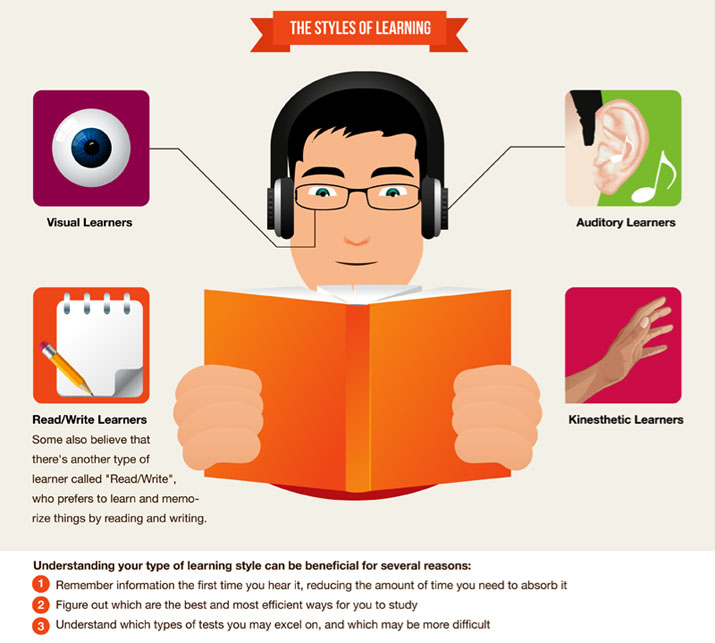
Reasons why knowing your child’s learning style is important:
1. You now know and understand how they think
- Knowing their learning style helps you to figure out how they process information and their style of thinking. If you know how they think, you’re better able to break information down in a way that they understand it.
2. It helps to explain their personality
- Once you discover their learning styles, their personalities make much more sense. For instance, auditory learners talk a lot and like to debate. Because they learn by hearing, it’s no wonder they like to hear themselves talk. Kinesthetic learners are busy-bodies. They simply cannot sit still; moving helps them process information.
3. It helps you to communicate with them better
- Once you know how your child learns, it’s easier to determine how to communicate with them. Giving verbal directions works well for auditory learners but not for visual learners. Visual learners need their directions written down for reinforcement. The more you know about your child’s learning style, the better your relationship can become due to better communication.
4. It helps you to help them study
- Understanding your child’s way of learning helps you to determine what methods of learning best fit their needs. Once you figure that out, it’s easier to implement effective study strategies. An example for visual learners is to utilize videos to demonstrate concepts or ideas. They will benefit more from seeing the video than you simply describing what to do.
5. It helps you understand their behavior
- Some of your child’s behavior may be explained by their learning styles. Familiarizing yourself with the characteristics of your child’s learning style will help you to understand why they act a certain way and aid you in addressing them appropriately and with more patience. For example, parents of kinesthetic learners find it difficult to get them to sit still while doing their work. Instead of becoming frustrated and forcing them to sit still, allow for structured movements such as bouncing on an exercise ball or doing a celebratory dance when they are done reading or have completed a math problem correctly.
6. It makes for a better relationship
- Once you understand your child’s learning style (and your own), the communication between the two of you gets better, your are able to apply effective strategies to manage their behavior, you know how they think and begin to use that to help them study effectively and even apply it to non-academic areas, your relationship with your child should improve. The best relationships are those in which each one understands one another and can communicate better.
Take a quick learning style assessment and have your child to take an age-appropriate learning style inventory. Check out more information about learning style personalties and resources for study skills.
Sign up now for FREE CLASSES that will go into detail about how to utilize learning styles to be successful in school and at home.
Sign up now for FREE CLASSES that will go into detail about how to utilize learning styles to be successful in school and at home.
Wednesday, February 5, 2014
Black History Trivia & Facts #2
|
|||||||||||||||||||||||


Black History Trivia & Facts
|
|||||||||||||||||||||


Friday, September 20, 2013
3 Reasons Why Waiting to Get Help is a BAD IDEA
CAN YOUR CHILD AFFORD FOR YOU TO WAIT?
|
|||||||||||||||||||||||||||||||||||||||


Friday, June 7, 2013
American Government and the Constitution
Georgia High School Graduation Test Review for Social Studies
This is your one-stop review for the most important parts of the American Government and Civics section and United States History as it pertains to the foundations of government for the GHSGT. For students looking to pass the test the first time or those remediation, this will help you to prepare for this section.
There are 5 steps:
- Study using the flash cards
- Check your learning by answering questions to determine what you know and what you don't know
- Review by playing games and quizzing yourself to ensure that you have indeed learned
- Test yourself by taking the test as many times as you would like by clicking HERE
- Contact Accelerated Learning Educational Services for additional tutoring assistance via in-home or live virtual tutoring by calling
855-3-TUTOR-ME (855-388-8676)
*Comment below to tell us how you're doing on the games, practices, and tests*
Geometry Review - Angles & Lines
The Quick Guide to Understanding Angles and Lines
This is your one-stop review for the most important parts of understanding Geometry as it relates to angles and lines. For students looking to pass the Geometry test the first time or those needing remediation, this will help you to prepare for this section.
There are 5 steps:
- Study using the flash cards
- Check your learning by answering questions to determine what you know and what you don't know
- Review by playing games and quizzing yourself to ensure that you have indeed learned
- Test yourself by taking the test as many times as you would like by clicking HERE
- Contact Accelerated Learning Educational Services for additional tutoring assistance via in-home or live virtual tutoring by calling
855-3-TUTOR-ME (855-388-8676)
*Comment below to tell us how you're doing on the games, practices, and tests*
Subscribe to:
Posts (Atom)